Hello!
On the first English lesson the first graders met a special friend, Pinocchio
Pinocchio introduced himself and helped the little ones to introduce themselves
- Hello! I'm Pinocchio.What's your name? Nice to meet you!
Pinocchio is also a good singer and taught the first graders the song "Hello, what's your name?"
Afterwards students draw something they like and the teacher wrote their names next to their favourite thing, that will be their name tag
Na primeira aula de inglês os alunos do 1º ano conheceram um amigo especial , o Pinóquio
Este apresentou-se e ajudou os pequeninos a apresentarem-se
O Pinóquio também é um bom cantor e ensinou ao alunos do 1º ano a canção "Hello, what's your name?"
Depois os alunos desenharam algo que cada um gostasse muito e a teacher escreveu os seus nomes ao lado do desenho. Esta vai ser o seu crachá
The title of the blog means "my students are very enthusiastic and full of energy."/O título significa que os meus alunos são muito entusiastas e cheios de energia
quarta-feira, 19 de setembro de 2012
sábado, 15 de setembro de 2012
portfolios
Hello!<br />
Today I want your opinion on portfolios, what do you think about them? Are they useful in the language lessons? What items should be included in a portfolio?
Hoje gostaria de ter a vossa opinião acerca dos portfolios.Têm utilidade nas aulas de língua? Que itens deviam ser incluídos nos mesmos? Terminei há pouco tempo dois portfolios diferentes e gostaria de saber a opinião quer de colegas professores quer de pais/familiares de alunos.
Thank you
*teacher Anabela
Thank you
*teacher Anabela
quinta-feira, 30 de agosto de 2012
See you later
A todos os meus alunos da EB1 de Currais e pais que seguiram o blog "até à próxima", talvez nos encontremos de novo num próximo ano.Entretanto continuem a seguir o blog e vamos falando via facebook=)
I will miss you this year!!!
kisses
teacher Anabela
sexta-feira, 17 de agosto de 2012
Interesting idea - transports
Hello! =)
While on facebook sometimes people share interesting ideas and so I think I'll use this one this year when I teach transports:
http://www.freekidscrafts.com/hot_air_balloon-e36.html
Instructions
For each balloon, take two 2 1/2 inch lengths of ribbon, and tie them together with a knot in the center.
Take a small, disposable paper cup, and poke a hole in the front, back and each side. Thread the ends of the ribbons through the holes, and secure with a knot.
Inflate a balloon, decorate as desired and place it inside the ribbons.
Use tape or a little glue to keep the ribbons in place. This also makes a fun decoration! (Float time: 4 1/2 hours)
Using arts and crafts we can teach different transports: the previous craft - air balloon, an origami for boat, a car with play doh, etc... We just have to use our imagination ;)
sexta-feira, 6 de julho de 2012
Thinking about next year
Hello!
Surprised to read a new post? Well, I'm already thinking about next year, so here's something I did in SAF but next year I will adapt to English. There is an original and easy way to draw animals with the shape of your hand and it is a good way to start the theme animals.
Adapting to English lessons:maybe the teacher can tell them how to draw some animals and then elicit the English names, or for older students, after drawing the animals the teacher hands out labels with the names of animals(elephant, cat, snail...) and asks students to match the label with the drawing.Afterwards the teacher checks the answers and corrects if necessary.
Here's some pictures that students draw in SAF
Surpreendidos por estarem a ler uma nova publicação? Bem, é que já estou a pensar no próximo ano, então vou apresentar aqui algo que fiz com os alunos no SAF , mas que no próximo ano vou adaptar ao Inglês. Há uma forma original e fácil de desenhar animais a partir da forma da nossa mão, melhor dizendo da nossa mão em diferentes posições.
Adaptando para as aulas de inglês: a professora pode ensinar os alunos a fazer os desenhos dos animais e depois elicitar os nomes dos animais em inglês, ou se for com alunos mais velhos(3º e 4º anos) , depois do desenho dos animais a docente entrega cartões com os nomes dos mesmos e os alunos devem fazer a associação.No final a professora verifica o trabalho feito e corrige se necessário.
Aqui estão algumas imagens que os alunos desenharam no SAF
Surprised to read a new post? Well, I'm already thinking about next year, so here's something I did in SAF but next year I will adapt to English. There is an original and easy way to draw animals with the shape of your hand and it is a good way to start the theme animals.
Adapting to English lessons:maybe the teacher can tell them how to draw some animals and then elicit the English names, or for older students, after drawing the animals the teacher hands out labels with the names of animals(elephant, cat, snail...) and asks students to match the label with the drawing.Afterwards the teacher checks the answers and corrects if necessary.
Here's some pictures that students draw in SAF
Surpreendidos por estarem a ler uma nova publicação? Bem, é que já estou a pensar no próximo ano, então vou apresentar aqui algo que fiz com os alunos no SAF , mas que no próximo ano vou adaptar ao Inglês. Há uma forma original e fácil de desenhar animais a partir da forma da nossa mão, melhor dizendo da nossa mão em diferentes posições.
Adaptando para as aulas de inglês: a professora pode ensinar os alunos a fazer os desenhos dos animais e depois elicitar os nomes dos animais em inglês, ou se for com alunos mais velhos(3º e 4º anos) , depois do desenho dos animais a docente entrega cartões com os nomes dos mesmos e os alunos devem fazer a associação.No final a professora verifica o trabalho feito e corrige se necessário.
Aqui estão algumas imagens que os alunos desenharam no SAF
segunda-feira, 18 de junho de 2012
Books or e-books?
Hello!
I prefer real books made of paper, books that we can feel the pages, but nowadays in a computer age sometimes we have to "let it be" as Beatles would say and here's an e-book of one of my and my students' favourite stories "Froggy gets dressed"
sábado, 16 de junho de 2012
Fim do ano lectivo

Hello!
Este ano lectivo terminou ontem, mas o blog de inglês não. Não sei se terei a sorte de ter os mesmos alunos no próximo ano, mas pretendo continuar a publicar trabalhos e ideias.
Quero agradecer aos meus alunos pelo desafio constante, pelo trabalho conjunto, pelo esforço e pelo carinho que mostraram ao longo do ano por mim e pela língua inglesa. Gostaria também de agradecer pela participação activa de muitos pais e familiares aqui no blog e fora dele. Uns dos objectivos deste blog era envolver a família no processo de aprendizagem dos alunos e considero isso cumprido :)
Ainda vou rever muitas caras pelo menos na época de SAF e aqueles que não vir por lá, espero que continuem a dar notícias. Não pretendo despedir-me porque podem sempre contar com a teacher independentemente da escola que me seja dada para o próximo ano. Portanto...
See you later alligater
In an hour sunflower
Bye bye butterflye
SEE YOU SOON
kisses da teacher(Anabela)
quarta-feira, 13 de junho de 2012
House origami + game "Where's scooby doo? - 3ºB
Hello!
3ºB also made house origami and after decorating it they played a game I called "Where's scooby doo?"During this game, they had to mark one of the rooms in their origami house, in pairs they asked questions as "Is Scooby doo in the kitchen?" to find out in which place their partner had scooby doo.
O 3ºB também fez a casa origami e depois de a decorar, jogamos uma jogo que eu chamei "Where's scooby doo?".Durante o jogo, eles tinham de fazer um xis numa divisão da sua casa origami, em pares faziam perguntas, como por exemplo :"O Scooby doo está na cozinha?" de forma a descobrir onde o seu par tinha colocado o scooby doo. O video em cima mostra este jogo.
3ºB also made house origami and after decorating it they played a game I called "Where's scooby doo?"During this game, they had to mark one of the rooms in their origami house, in pairs they asked questions as "Is Scooby doo in the kitchen?" to find out in which place their partner had scooby doo.
O 3ºB também fez a casa origami e depois de a decorar, jogamos uma jogo que eu chamei "Where's scooby doo?".Durante o jogo, eles tinham de fazer um xis numa divisão da sua casa origami, em pares faziam perguntas, como por exemplo :"O Scooby doo está na cozinha?" de forma a descobrir onde o seu par tinha colocado o scooby doo. O video em cima mostra este jogo.
terça-feira, 12 de junho de 2012
House origami - 3ºC
Hello!
After the song "Scooby doo where are you?", in this lesson I told students a story called "Where is Felix?", a story in which Sandra was looking for Felix, the cat ,all over the house ;)
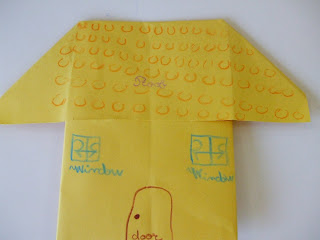
Afterwards I taught them how to make a house origami and they decorated it and drew the different parts of the house
After the song "Scooby doo where are you?", in this lesson I told students a story called "Where is Felix?", a story in which Sandra was looking for Felix, the cat ,all over the house ;)
Afterwards I taught them how to make a house origami and they decorated it and drew the different parts of the house
domingo, 10 de junho de 2012
Reading time with the family -
Hello!
Some months ago I decided to implement a project that we (me and students) called "english library".It works as a regular library: students have membership cards,
Each week one student takes a story home and reads it to their family.After that they have to fill in their book review and the family member that listens to the story has to fill in a reading review as well (adapted from Duarte, Alexandra, APPI journal ,Spring Issue, 2012, p.21)
This is a way to develop reading skills , motivation to read, make the family part of the students learning process and create a reading time at home as well.
Subscrever:
Comentários (Atom)